
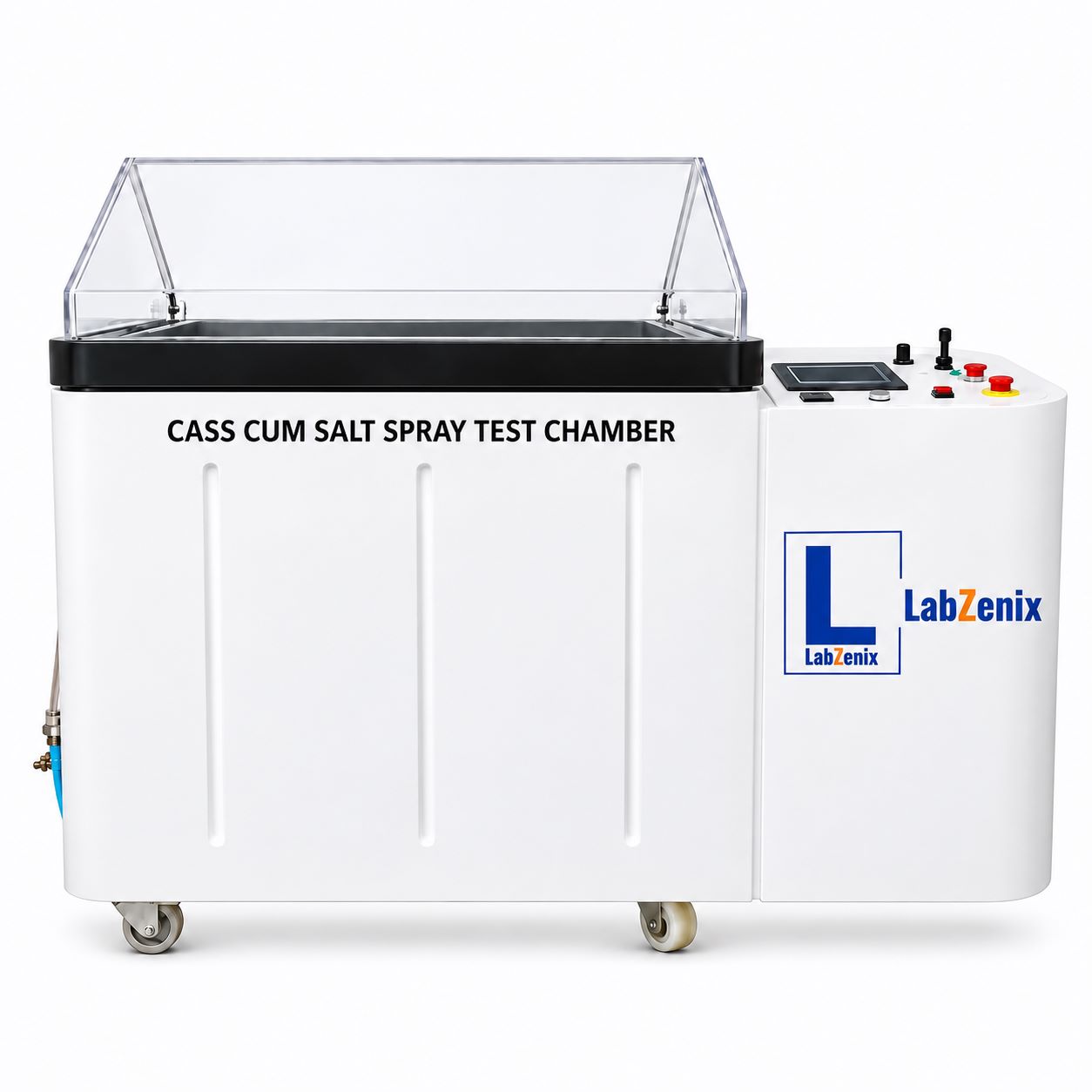
CASS Cum Salt Spray Chamber – LabZenix Corrosion Testing Solutions
A smooth finish can hide weaknesses that become visible only after exposure to corrosive conditions. For manufacturers, identifying these weaknesses before dispatch helps prevent coating failures, customer complaints and unnecessary rework. A CASS Cum Salt Spray Chamber supports this quality control process by exposing prepared specimens to a controlled corrosive environment.
LabZenix serves the Paint, Plating & Coating Testing Instruments industry with corrosion testing solutions for laboratory and production quality requirements. Selecting the right chamber begins with understanding the coating, applicable test method and customer acceptance criteria.
🔬 What Is a CASS Cum Salt Spray Chamber?
A CASS Cum Salt Spray Chamber combines facilities for copper-accelerated acetic acid salt spray testing and conventional salt spray testing, subject to the selected equipment configuration. These methods evaluate protective finishes under specified laboratory conditions.
CASS stands for Copper-Accelerated Acetic Acid Salt Spray. It is particularly useful for assessing certain decorative nickel/chromium and copper/nickel/chromium coatings. Neutral salt spray testing serves a broader range of metallic materials and protective coatings. The appropriate method depends on the product specification rather than simply choosing the more aggressive exposure.
⚙️ How Does the Testing Process Work?
Inside a CASS Cum Salt Spray Chamber, a prepared solution is atomized to establish the required fog environment. Specimens are positioned so their exposed surfaces receive the specified exposure without unwanted interference from adjacent samples.
Operators monitor the conditions required by the chosen method, including temperature, solution chemistry and fog collection. After the prescribed exposure, samples are examined for relevant changes such as corrosion, blistering or coating deterioration.
Meaningful results depend on consistent specimen preparation, controlled operation and clearly defined evaluation criteria. Recording these details makes subsequent investigations easier.
🛡️ Why Corrosion Testing Matters
Coating appearance alone cannot establish protective performance. Small discontinuities, inconsistent pretreatment or variations in plating can affect how a finished component behaves during testing.
Using a CASS Cum Salt Spray Chamber helps quality teams investigate process consistency and check whether production samples meet an agreed specification. Results can support discussions between coating suppliers, component manufacturers and buyers.
For example, recurring corrosion around edges may prompt a review of coverage or preparation. A change following a production adjustment can guide further investigation. The chamber provides controlled exposure; the quality team interprets the findings alongside manufacturing records.
📋 Relevant ASTM, ISO, JIS and Indian Standards
A CASS Cum Salt Spray Chamber should be selected against the actual methods required by the laboratory. Relevant references include:
ASTM B117: Defines apparatus and operating conditions for salt spray exposure; it does not independently establish product acceptance limits.
ASTM B368: Specifically addresses copper-accelerated acetic acid salt spray testing and its intended coating applications.
ISO 9227: Covers neutral salt spray, acetic acid salt spray and CASS procedures.
JIS Z 2371: Specifies salt spray testing methods, including neutral, acetic acid and CASS testing.
IS 5528:2024 / ISO 9227:2022: Provides the relevant Indian Standard reference published by the Bureau of Indian Standards, or BIS.
Equipment suitability, operating procedures and verification must match the applicable standard. Referencing a standard does not itself establish certification.
🏭 Applications Across Manufacturing Industries
A CASS Cum Salt Spray Chamber can support several industries when the exposure method suits the component and coating.
Automotive: Plated trims, fasteners, fittings and coated components may require corrosion testing against customer specifications.
Defense: Selected metal parts, housings and protective finishes may undergo specified corrosion evaluations within a wider qualification programme.
Electronics and electrical manufacturing: Coated enclosures, brackets and suitable metallic components can be assessed using the relevant method.
Paint and powder coating: Prepared metal panels help laboratories investigate finish quality and production consistency.
Paper and packaging: Applications concern suitable coated metal closures, fittings, containers and machinery components. Salt spray testing should not be presented as a general test for paper itself.
✅ Features to Consider Before Selection
When evaluating a CASS Cum Salt Spray Chamber, start with specimen dimensions, daily workload and required test methods.
Useful selection points include corrosion-resistant construction compatible with the intended chemistry, dependable temperature control, accessible specimen supports and practical fog collection arrangements. Clear controls and straightforward cleaning access also make routine laboratory work easier.
Ask LabZenix to confirm the proposed model’s temperature capability, wetted materials, solution handling, control system and available protection features. Data recording, alarms and automatic functions should be specified according to the supplied configuration. This creates a clearer purchase specification and avoids assumptions about standard equipment.
🔄 Managing Different Test Methods
Operating a CASS Cum Salt Spray Chamber across different chemistries requires careful planning. Laboratories should establish documented procedures for solution preparation, cleaning, changeover and verification before starting another method.
A combined chamber does not mean operators can immediately switch from an acidic, copper-containing exposure to neutral salt spray. Confirm the applicable method’s requirements and the manufacturer’s approved changeover procedure. Where carryover cannot be adequately controlled, separate equipment may be appropriate.
📊 Turning Results into Better Decisions
A CASS Cum Salt Spray Chamber delivers greater value when testing records connect directly with production information. Record sample identity, coating details, preparation, exposure duration, observations and acceptance criteria.
Photographs taken consistently can help document changes. Reviewing these records alongside pretreatment and plating data supports practical corrective action.
Laboratory exposure hours should not be converted directly into years of outdoor service. Salt spray findings need interpretation within the product’s wider performance requirements.